
first galaxy post
An Introduction to the game as a project
DEV
Isaac
2/21/20244 min read


Galaxy League Online is being developed in Unreal Engine 5, but its roots lie deep in the history of the first video games. In that pre-dawn, before home computers and video arcades, came the two-player competitive game Spacewar!, running on a PDP-1 minicomputer. While few have played it, millions can still recall its best-known descendant, the classic single-player space shooter: Asteroids.
Both of these legends shared a formula, simple 2D physics for flying and fighting, creating the kind of magic balance described by Nolan Bushnell as easy to learn, difficult to master.
Upgrades
But Galaxy League Online is about a lot more than just a better version of some old game. In the last two decades, standards in technology and mechanics have come a long way, as have communities and various platforms supporting them. We use these developments and inspirations to become something altogether new in the multiplayer top-down 2D space shooters.
Engines
Today, engines are mature software products supporting an expansive set of industries beyond just gaming, like film, education, health care, etc. I had been using Unity from 2008 (also when I first started using Macs, which I bought to develop with it) to about 2017 when I got re-introduced to Unreal and really fell for it (which I develop on PCs because Macs, pound for pound, dollar for dollar, still suck butthole for 3D game development).
Working with Unreal has been fantastic. With only a few years of experience with it, I've been able to create a new technical design that satisfies feature requirements almost entirely native Unreal components. Any other engine would need several months of additional development. In years past, I've prototyped the basic movement and combat in Unreal 4.2 and earlier in Unity.
When I started on this, I’d expected to stick with UE4. UE5’s official release was a few months out, at that time, and I didn’t want to get into untested waters if I was going to be the primary engineer—I’m really not a great programmer. Because of default world size limitations, and the difficulty of using something like World Composition in a multiplayer environment, I’d settled for a space fighting MOBA, in a small contained level. But not long after UE5 shipped, Epic introduced the World Partition system for doing large spaces. This was the solution I’d been waiting for. It forced my hand, and I knew I'd need to switch. And with that, against my usual advice of keeping things simple, I bit the bullet and restarted the project. It’s set me back a while as there have been a few more things to learn.
But now we’re beginning to build some real momentum. Once the project is in a state where there is something resembling a real codebase, Basic Array can rely on the popularity of Unreal when bringing in collaborators; technical artists, real engineers, game designers... it feels like everyone knows how to use Unreal these days.
Mechanics
Just as engines, standards in game mechanics have evolved over the years following Subspace. Game designers have explored whole new genres and complex dynamics, and audiences have learned right alongside them. So while cool weapons mounted onto spaceships has been a thing since the beginning, ways of upgrading and paradigms for game modes have grown through generation after generation. Spaceship systems, setups and loadouts get cooler and cooler, from Wing Commander to X and Elite Dangerous, kickass configurations on boss-ass spaceships is a classic feature.
From RPG's through MOBA's, powerful hero characters with specialized skills and abilities have also become standard fare. Players are used to these unique unit configurations into classes and roles, allowing complex strategies to become regularized so that strangers can be expected to share some of this knowledge and skill, being able to rely on community conventions and theorizing to be understood by most enthusiasts.
But just because standards have changed, does not mean that every game needs to follow a formula. There are certain matchmaking schemas, for example, that really only work when a game is operated as a service. Galaxy League is design to be different, but we’ll leave that topic for another post…
K THX BAI!
In the meantime, please accept this personal welcome from me to you. Thank you so much for being here!
— Isaac “PilotPrecise”
Galaxy League Online is directly descended from a lost multiplayer classic from the 1990's: SubSpace, that took the classic formula and created the first commercial TCP/IP Internet multiplayer action game.
While adding groundbreaking features like multiplayer support for hundreds of concurrent players, multiple ship types, a collection based upgrade system, and more, it also introduced improved controls and an elegant damage model that deepened the flight and fight experience. Pilots became duelists, wielding their spaceships like elegant weapons.
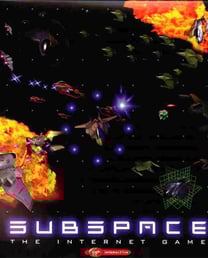
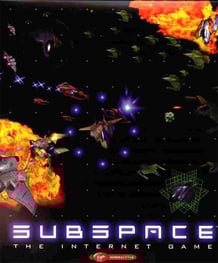
"If it was so good, why haven't I heard of it?" you might ask. Well, tragically, SubSpace was doomed, the victim of bad client-server architecture. (Wikipedia gets this history wrong.) As one of first TCP/IP Internet multiplayer games, it failed to understand the most important multiplayer architecture maxim: never trust the game client. A month after its retail release, the first cheater, "FortyL3Bombs," appeared in Chaos West. Soon, they were everywhere. With no economical way to reengineer the entire game, Virgin Interactive pulled it from store shelves. When the servers were taken offline, they were already dead, the fun having been decimated by rampant cheaters.
But this old game can be, and is, still be played as free community-supported clients and servers have sustained it, such as SubSpace Continuum. A passionate group of players continue to compete, but still the only solutions to cheaters are punitive, after-the-fact bannings, or restrictive whitelist applications. Open public modes are impossible to fully moderate and, therefore, still wrecked.
